
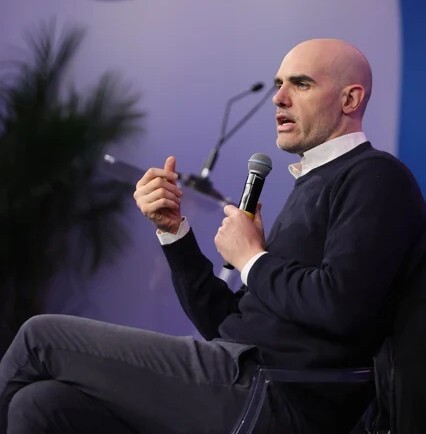
Global Turmoil: Conflicts, Trade, and New Power Dynamics with Dario Fabbri
Among the key moments of the day, the meeting dedicated to global turmoil brought back to the forefront a reality that no sector can afford to ignore: international conflicts and tensions are reshaping markets, supply chains, and power dynamics in real time. This is not a “calm” phase, but an unstable moment unsettling precisely because Europe has lost the habit, and perhaps the tools, to read conflict as a structural element of history.
Tariffs, open crises, new strategic routes, and territories returning to the center of power dynamics such as Greenland or the Panama Canal are clear signals of a rapidly changing scenario. A context that directly impacts eyewear as well, affecting exports, sourcing, competitiveness, and international positioning strategies.
The talk featured Dario Fabbri, journalist and geopolitical analyst, who with his usual clarity offered a framework for understanding the transforming economic and political balances. The meeting was introduced by Simone Lijoi.
Starting from the United States, the analysis also examined other international contexts directly linked to Washington’s actions and strategies, from Greenland to Venezuela. The United States emerged as a country experiencing a deep economic and identity crisis, marked by the decline of manufacturing, technological challenges, and widespread social frustration. In this context, Donald Trump is not interpreted as an anomaly, but as the expression of a significant portion of deep America.
According to Dario Fabbri, the true center of gravity of U.S. strategy remains the confrontation with China: from tariffs to pressure on strategic areas such as Panama and Greenland, to attempts to freeze the conflict in Ukraine and tactically reopen dialogue with Russia everything responds to a logic of containing Beijing. In this scenario, Iran remains a marginal actor, with limited weight in the new global balances.
In closing, the discussion highlighted the limits of the Western interpretation of current international balance, underscoring Europe’s difficulties in understanding an increasingly unstable and competitive global context.
A contribution that added depth to the day, confirming the value of the MIDO exhibition as a platform capable of connecting product and scenario: because today, innovation does not only mean developing solutions, but understanding the world unstable, conflictual, and competitive in which one operates.