
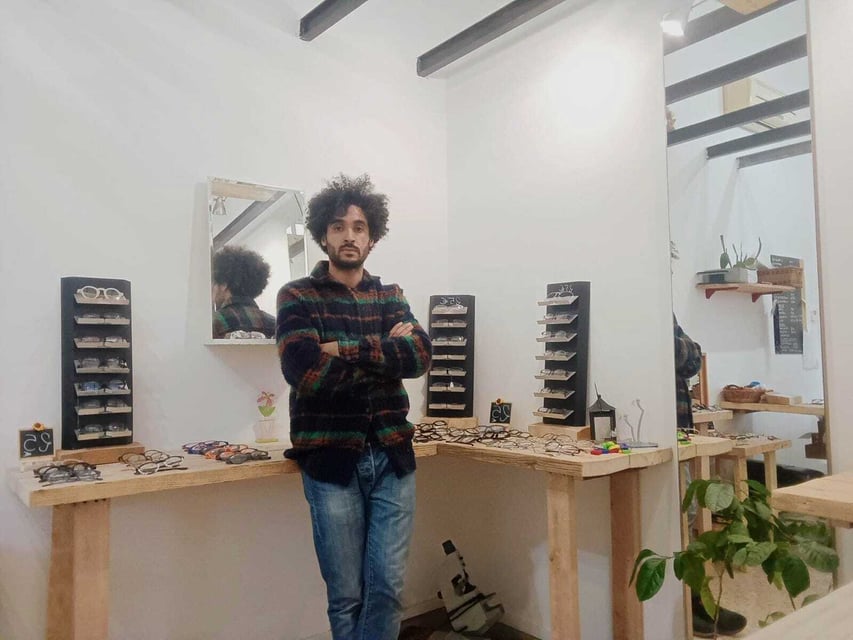
“I’m staying here”: the social optician in Turin standing strong after the break-in
The story of Morad Eddakuri and his optical shop: a project born to give back to the neighborhood and break down economic and cultural barriers.
The shop window smashed, the store ransacked, and thousands of euros worth of frames stolen. But Morad Eddakuri, 36, has no intention of stopping.
In his shop — a social optician in the heart of Barriera di Milano, Turin, at 267 Corso Giulio Cesare — he builds something that goes beyond business every day.
We spoke with him to understand what it means to stay, in a place many choose to leave.
Smiling, straightforward, and clear in his vision: his is not just a business, but a deliberate choice.
What does Ottica Dal Moro represent to you, and why did you choose to open it here?
“It’s a way of giving back. I was born in Morocco, and when I first arrived here I lived in a very poor attic. Shortly after, we were assigned a public housing apartment: large, decent. That’s where I could study, play football, grow up.
This business is my way of giving something back to public housing and to this community. I didn’t want to leave like many people do. I chose to stay, face reality, and contribute in my own way.”
And Barriera di Milano is not a random choice:
“I’m useful here. I speak Arabic, French, English. Many people feel uncomfortable even entering an optical shop: they’re afraid of not understanding, of paying too much, of being taken advantage of. I want to give them clarity, in their own language.”
What is the mission of your shop? How do you concretely help the local community?
“Barriera is a complex neighborhood, slowly evolving.
The first concrete help is eye testing. Many Italians focus on prevention, but many foreigners have never even been to an optician. They come in with serious issues. I’m not a doctor, but when I notice something wrong, I refer them to an ophthalmologist — and that starts a proper prevention process.”
Then there’s the economic aspect:
“I offer discounts to people with an ISEE under €10,000 and to those living in public housing. I try to eliminate unnecessary costs: no intermediaries, minimal advertising, very low margins. I want prices to be accessible.”
Who are your main customers? What needs do you encounter most often?
“The number one factor is price.
The second is trust. People don’t know anything about optics — they just want someone they can rely on, someone who does a good job without overcomplicating things or inflating prices.”
And trust is at the core of his daily work:
“I try to make everyone feel comfortable. Sometimes I can tell when someone feels embarrassed, maybe because they struggle to read — so I adapt, I use symbols or images. The important thing is to make them feel at ease.”
His business choices reflect this philosophy:
“I offer low-cost frames. I don’t focus on brands. I display prices outside — so people know what to expect before they even walk in.”
After twelve years of experience — from workshops to high-end optical stores — he decided to open his own space. But his goal today is different:
“I wanted to create a place I enjoy going to every day. A place that is useful for the community.”
Despite the break-in, the doors of Ottica Dal Moro remain open.
And among frames and tools, what is built every day goes beyond vision: it’s a human connection, based on trust, care, and presence.
Photo courtesy of Morad Eddakuri